The Human Frontier: Why AI is Making Theater Relevant Again
The Crisis of the Infinite
We are living in an age where the line between reality and simulation has not just blurred; it has been erased. With a single prompt, a computer can generate photorealistic images, write complex music, or pop out videos that look real. But as our digital world becomes saturated with AI-generated content, a powerful new kind of fatigue is setting in. It is not necessarily a fatigue with the technology itself, but a fatigue with the uncertainty.
People are tired of wondering what is real. They are tired of the guessing game of whether a video was made by a person with human creativity and talent, or a machine. When a digital avatar performs a “feat” on a screen, the audience’s reaction is no longer “How did they do that?” but rather “Which model did they use?” The “wow factor” has been replaced by a shrug.
As a result, audiences are reaching a powerful, instinctive conclusion: The only way to be absolutely sure that what you are experiencing is authentic is to go see it live.
The Living Proof in the Room
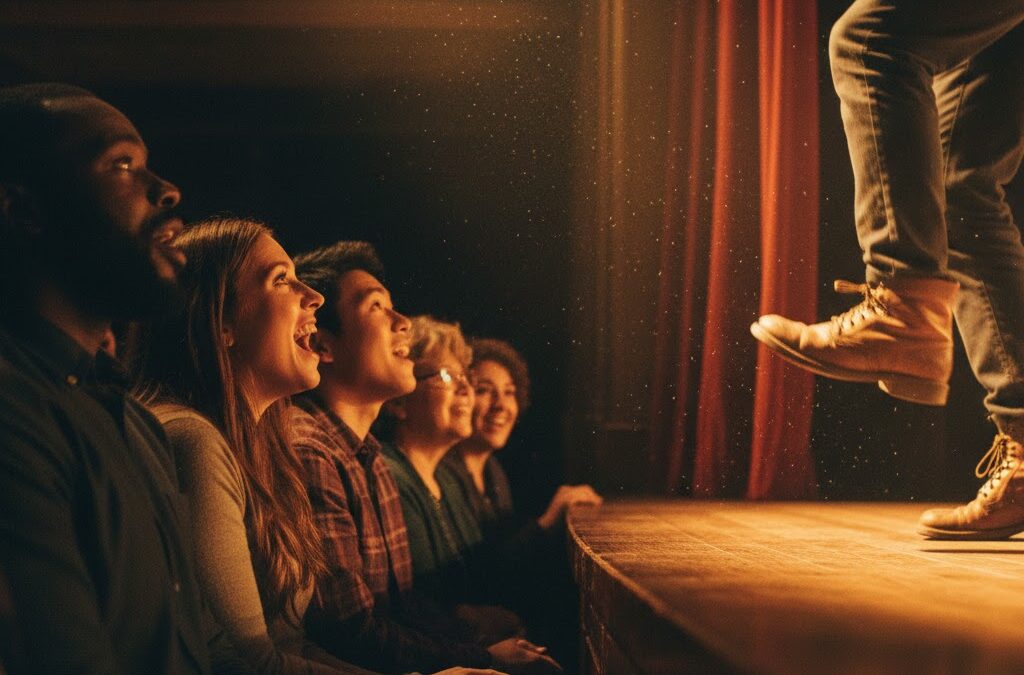
This is where the theater finds its new, aggressive relevance. In a world of deepfakes and bot-written scripts, the stage is the last frontier of human truth. You cannot “Generate” the energy of an actor standing ten feet away from you. You cannot “Prompt” the collective breath of an audience in a shared space.
When you sit in a theater, you are a witness to a physical fact. Whether it is a high-stakes drama or a concert, the value of the experience comes from the certainty that a human being is doing the work in real time. We are biologically wired for human engagement. We crave the sight of amazing feats and talents that we can’t believe are real. In the past, we looked for these feats on our screens. But now that those screens are filled with artificial perfection, that perfection has become cheap.
The “living proof” is now the ultimate luxury. When an actor hits a high note that makes the hair on your arms stand up, you know it is real because you are breathing the same air they are. You are seeing the sweat, the effort, and the raw vulnerability of a person risking failure. There is no algorithm that can replicate that level of trust.
The Power of the Unrepeatable Moment
One of the greatest paradoxes of the modern age is that technology has made everything permanent, yet nothing feels significant. We can record every moment, but we value those moments less because we know we can just hit “replay.” Theater stands in direct opposition to this digital permanence. When you sit in a theater watching a show—even a show that is currently being performed in thousands of other venues around the world—you are witnessing a one-of-a-kind event.
This is the “Human Hinge” upon which the entire industry turns. Every performance is a unique ecosystem. It is a moment in time that belongs only to the people in that room, on that night, and it will never exist in exactly that way again.
The Human Crackle: Embracing Frailty
In a digital simulation, there is no such thing as a “mistake” unless it was programmed to be there. But in the theater, the potential for failure is what creates the “crackle” of energy in the air. We are drawn to the human frailties that AI can never simulate. We want to see the actor who trips over a line and saves it with an adlib so sharp the audience never knows there was a flub. We want to see the raw, unplanned emotion that breaks through a scripted scene because of something the actor felt in that specific moment.
When you see a “feat” accomplished on a screen today, you know it was polished by a hundred different software passes. When you see it on stage, you are seeing the result of physical stamina and human focus. This realization changes everything about how the performance is absorbed. It is stored in the memory not just as “content” we consumed, but as an event we survived and shared.
The Biological Synchronization
There is a palpable energy in a live room that changes the very chemistry of the audience. Scientific studies have shown that during a live performance, the heart rates of the audience members often begin to synchronize. They start to breathe as one. This is “Neural Coupling” in its purest form. It is the biological proof that we are social creatures who crave engagement.
This is why a filmed version of a play can never replace the play itself. On a screen, you are an observer looking through a window. In the theater, you are a participant in a shared energy field. The way you absorb the story is deeper because your body knows the difference between a pixel and a person.
The Great Disconnection: Why the World is Turning Back
To understand the future of the stage, we must look at the current state of the world outside the theater doors. We are moving through a cultural “Great Disconnection.” In 2026, the average person is bombarded by thousands of digital impressions daily. Most of those impressions are curated by algorithms designed to keep them scrolling, and increasingly, those impressions are entirely artificial.
This has created a deep-seated “Reality Deficit.” When every photo on social media is filtered, every news clip is potentially a deepfake, and every customer service interaction is a chatbot, the human psyche begins to crave a “Zero-Digital” environment. This is why we are seeing a massive surge in live entertainment. It is not just about the art; it is about the Evidence of Life. The Rejection of the “Cheap Infinite”.
For the last decade, the tech world promised that “Infinite Content” was the goal. But they forgot one basic rule of economics: when something becomes infinite, its value drops to zero. AI can now produce a “perfect” symphony or a “perfect” movie in seconds. Because it is easy and infinite, it has become cheap. It lacks the “Human Tax”—the investment of years of practice, physical sacrifice, and the literal life-force of a creator.
Audiences are waking up to this. They realize that a digital “feat” costs the creator nothing, so it is worth nothing to the viewer. In contrast, when a community theater troupe spends three months rehearsing a complex musical number, the audience can feel the “tax” that was paid. They see the physical effort. They see the sweat. They are witnessing a feat that cost something to produce. In an age of cheap digital abundance, Effort is the new Luxury.
The Sanctuary from the Noise
The theater has become one of the last places on earth where a person is required to disconnect. It is a physical sanctuary. For two hours, the phone is dark. The blue light is gone. The “infinite scroll” is replaced by a single, focused narrative.
This “Forced Presence” is the hidden reason people are seeking out live shows. They are tired of the fractured attention spans that AI-driven platforms have forced upon them. They want to be part of a story that doesn’t have a “Skip Ad” button. They want a reality that is loud, tactile, and undeniably human. As the world becomes more artificial, the “Live” experience becomes the only place where the audience can finally stop guessing and start feeling.
The Era of the Digital Lie
The pivot toward live performance is being driven by more than just fatigue; it is being driven by a fundamental breakdown in trust. We have entered the era of the “Digital Lie.” Bad actors, equipped with the most powerful generative tools in history, are flooding our screens with content designed to deceive. They are creating photorealistic simulations and failing to disclose their artificial origins. They are deliberately blurring the lines, hoping to pass off machine-made clones as human creativity.
This has forced the modern consumer into a state of perpetual cynicism. We have reached a point where we are unsure of everything we see on a screen. We find ourselves accidentally shutting down real, heartfelt human art because we suspect it might be a clever algorithm. Conversely, we find ourselves coveting digital lies, only to feel a sense of betrayal when the curtain is pulled back. This constant “reality-checking” is exhausting. It creates a psychological friction that leeches the joy out of art.
The Only Path to Protection
In this environment, the only way for an audience to protect themselves from the deception of the bad actors is to remove the screen entirely. The theater offers the ultimate security protocol: Physical Presence. When you are in the room when the art is created, the “Guessing Game” ends. You are not watching a file that was uploaded to a server; you are watching a process that is unfolding in real time. You are seeing the breath, the muscle tension, and the raw focus of a performer who is standing right in front of you. This is the only place where the “Digital Lie” cannot survive. You can trust what you see in a theater because the laws of physics and the limitations of the human body act as a natural firewall against simulation.
For the producer and the artistic director, this shift in the cultural landscape is a call to action. You are no longer just providing a “night out.” You are providing a sanctuary of truth. You are offering the one thing that a dishonest digital world can never provide: Living Proof.
The Producer’s Blueprint: Marketing the Real
Knowing that the world is starving for authenticity is only half the battle. For the theater professional, the challenge is translating this psychological hunger into ticket sales. If the “Digital Lie” is the problem, then Radical Transparency is your marketing solution.
The most successful producers of 2026 are no longer selling “a play”; they are selling the process. To draw in an audience that is cynical of polished digital content, you must pull back the curtain. Show them the “Human Tax” being paid. Share the footage of the grueling dance rehearsals, the sweat of the tech week, and the messy, iterative work of finding a character. When the audience sees the labor, the value of the final ticket increases. They aren’t just buying a seat; they are investing in human effort.
The Strategy of Presence
To leverage the “Reality Deficit,” theater marketing must stop trying to compete with cinematic trailers. Instead, lean into the tactile. Use your marketing to highlight the sensory exclusivity of the theater: the smell of the greasepaint, the vibration of the orchestra, the literal shared breath of the crowd.
Create “Un-Replicable” events. Consider “Process Nights” where the audience can watch a scene being built or talk-backs that focus on the physical demands of the craft. When you market your show, do not promise “perfection”—AI can do perfection. Promise presence. Promise an experience that cannot be downloaded, pirated, or generated.
The Biological Advantage
Finally, understand that your greatest marketing tool is the biology of your audience. In a world of isolated screens, the “Bio-Sync” of a live room is a high-end luxury. Market your theater as a digital sanctuary—a place where the phone stays in the pocket and the brain is allowed to focus on a single, human truth.
The benefit to the theater is a new kind of loyalty. When an audience member realizes they can trust what they see on your stage, they become more than just a ticket holder; they become a participant in your community. By leaning into the “Live” in live entertainment, you aren’t just filling seats for one night. You are rebuilding the foundation of human trust, one performance at a time. The future belongs to those who can prove they are real.
Using These Concepts
Ready to turn these AI concepts into a show-ready reality? Pick our brains at the TLC Scripts Wiki for the “Trust but Verify” audit and the tactical blueprints you need to master the backstage.