
by Tracy Byrne | Feb 9, 2026 | Producer Tips, Theatre Management
You finally found it. You spent weeks reading scripts, humming through demo tracks, and weighing cast sizes. You found the show that fits your budget, your talent pool, and your audience. Your board is ready to vote, your director is inspired, and the energy is high. Then, you hit the button to apply for theatrical licensing rights…
And you wait…
and wait…
and wait…
For many community theaters and small professional companies, this is where the momentum dies. You’re stuck in “Licensing Limbo” for two weeks while a massive corporation checks “territorial restrictions” or waits for a manual review from a department that doesn’t know your theater exists.
The Cost of Waiting for Theatrical Licensing Rights
When you have to tell your team, “We’re waiting to see if we’re allowed to do the show,” you lose the window to book your performance dates, create your rehearsal schedule, start your marketing, or lock in your lead actors.
But in theater, securing your theatrical licensing rights isn’t just about logistics and money; it’s about morale.
When a creative team finally lands on the “perfect” script, there is a surge of collective energy. You can see the set in your head, the actors are already imagining their auditions, and the board is energized to sell the vision. But when you have to tell that team that the show is essentially “on hold,” you effectively put inspiration on ice.
Every day spent in “Licensing Limbo” drains that initial spark. You aren’t just risking your venue’s availability; you are risking the “buy-in” and availability of your volunteers and staff.
-
The “Why” evaporates: It’s hard to stay passionate about a project that is currently a “maybe” in a corporate database.
-
The Pivot Fatigue: If the answer comes back as a “No” after three weeks of waiting for play rights, your team has to start the entire emotional climb over again with a second-choice script.
-
The Stagnation: Theater people are “doers.” Making them sit on their hands while a bureaucrat checks a map is the fastest way to turn a passion project into a chore.
The TLC Difference: Fast Play Licensing
At TLC Scripts, we approach theatrical licensing rights differently. When you reach out about a script, you aren’t hitting a faceless database that’s quietly checking to see if a professional house in the next county wants “first rights” over you.
Large corporations often hold your application in limbo while they protect their biggest clients or wait for a national tour schedule to be finalized. At TLC, we don’t have a “pecking order.” We own our catalog outright, which means we don’t have to “check with an estate” or wait for a third-party legal team to clear a zip code.
Our standard is fast play licensing with a 48-hour turnaround. We believe a 100-seat community theater deserves the same respect and speed as a 1,000-seat professional house. We want our scripts on your stage, not sitting in a “pending” folder while a bureaucrat waits for a “better” offer.
Don’t let a slow bureaucracy dictate your production schedule. If you’re tired of the waiting game for theatrical licensing rights, it might be time to look at a catalog that moves at the speed of live theater.
by Tracy Byrne | Feb 2, 2026 | Producer Tips, Theatre Management
The Dead Weight of the Old Guard
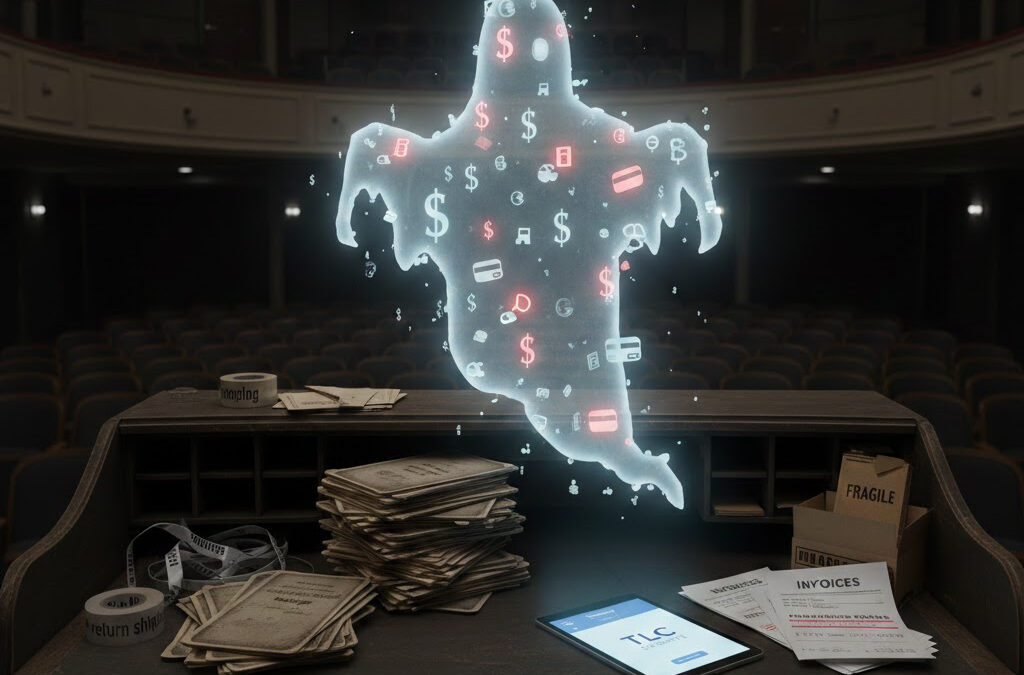
Every producer knows the “Big Three”: Venue, Insurance, and Royalties. These are the fixed stars you navigate by. But there is a ghost in your budget that most producers don’t see until the final reconciliation. It is the invisible friction of the “Traditional” script model—a system designed for a world that no longer exists.
When you license from the legacy houses, the royalty is often just the cover charge. The real “Ghost” is the secondary economy of logistics. You pay for script rentals. You pay for shipping. You pay for the “privilege” of returning those scripts by a deadline. If a script is lost or a page is marked in ink, the “security deposit” vanishes. This isn’t just a cost; it is a liability. It is a system that views the producer not as a creative partner, but as a temporary custodian of paper.
The Digital Surveillance State
Even as the industry moves toward digital materials, the legacy model has mutated into something even more restrictive: The Surveillance Model. Many publishers now track their PDF files with a level of jealousy that borders on the absurd. They have replaced the “Shipping Fee” with the “Access Fee.”
In 2026, we see publishers charging per-cast-member download fees. If you have a cast of twenty, you pay twenty times for the exact same digital file. Some go further, utilizing proprietary apps that prevent you from sharing a script with your Lighting Designer or a guest Stage Manager without “authorization.” They use digital watermarking to track your files like evidence in a criminal trial. You are paying for a script you never truly own, under a contract that requires you to “destroy” your digital history the moment the curtain falls.
The Freedom of the Digital Master
The industry is long overdue for a shift toward Production Autonomy. The solution isn’t just “digital files”—it is the “Digital Master” model. By removing physical rentals and per-user gatekeeping, we can finally kill the hidden costs that haunt a production.
A Digital Master model is about more than just saving on shipping. It is about Operational Velocity.
- Zero Latency: Your actors have scripts on their devices the second the show is cast.
- Zero Liability: No return deadlines, no “lost book” fees, and no shipping-related stress.
- Print-to-Need: You print only what you need, for who needs it, without asking for permission.
From “Permission” to “Partnership”
The theater world is expensive enough. Producers should not be made to feel like they are “renting” their creative vision from a landlord. You shouldn’t be penalized for being efficient.
We need to stop accepting the “Ghost Fees” as a necessary evil. It is time for a licensing model that trusts the producer, respects the budget, and treats the script as a tool for success rather than a monitored asset. Wouldn’t it be nice to finally find a licensing partner instead of just another licensing house?
The Parasite vs. The Partner
The Revenue Myth
The big houses defend these fees as “revenue maximization.” They claim that every digital watermark and shipping surcharge is necessary to protect the bottom line. But this is a hollow defense. They are failing to account for—or simply ignoring—the fact that their customers are at a breaking point. By nickel-and-diming the very theaters that keep them in business, they are slowly killing the industry that feeds them.
It is a parasitic relationship. When a licensing house prioritizes a $50 “access fee” over a theater’s ability to survive another season, they are trading their future for a rounding error.
The Incentive Alignment
Imagine a different model. What if a licensing house stopped focusing on “access” and started focusing on Impact?
In a partner-based model, the income of the licensing house is tied to the success of the show—not the number of PDF downloads. The math is simple: if the theater makes money, the licensing house makes money. When a partner is invested in the # of seats sold and the # of performances planned, their goal shifts. They are no longer a gatekeeper; they are an advocate.
A true partner doesn’t just send a script and a bill. They provide the marketing tools, the digital masters, and the strategic support to ensure the house is full. Why? Because a full house on a third weekend of a run is worth more to a licensing house than a thousand “shipping and handling” fees. By removing the “Ghost” costs, you allow the theater to reinvest that money into the production itself—better sets, better costumes, better marketing—which in turn draws a larger crowd.
The Multiplier Effect
When the Licensing House goes “all in” on the theater’s success, they create a multiplier effect. A theater that isn’t being bled dry by hidden fees is a theater that can afford to take risks on new shows. They can afford to license more frequently. They can afford to grow their audience.
The legacy model is based on scarcity and control. The future model is based on scale and success. It is time to stop paying the ghosts of the past and start investing in the partners of the future.
The Symbiosis of Success
The ultimate irony of the legacy model is that by trying to squeeze the producer, the licensing house is actually limiting its own payday. Every dollar spent on a “shipping fee” or a “digital download surcharge” is a dollar that cannot be spent on the production itself.
When a theater is freed from these predatory costs, they have more than just a balanced budget—they have options. A theater that can actually afford its production is a theater that has the confidence to add more performance dates. And this is where the true symbiosis begins.
In a partnership model, the licensing house wins when the theater wins. If a show is a hit and the producer adds a second or third weekend because the “Ghost Fees” didn’t kill their margins, the royalties for those extra performances go directly to the licensing house. It is a virtuous cycle: the LH provides the tools for success, the theater uses those tools to sell more seats, and both parties walk away with a larger, more sustainable profit.
The industry must move from a state of confrontation to a state of collaboration. We should be working together to fill every seat, not fighting over the cost of a PDF. When the licensing house stops acting like a toll collector and starts acting like a stakeholder, the entire theater ecosystem flourishes.

by Tracy Byrne | Jan 12, 2026 | Producer Tips, Theatre Management
Why Small-Cast Productions are the Producer’s Secret Weapon
In the theater world, scale is often confused with impact. We have all witnessed massive productions with thirty-person ensembles that felt emotionally hollow. Conversely, we have seen four actors on a bare stage hold an audience breathless for two hours.
For the 2026 producer, the small-cast play is not a compromise. It is a Strategic Weapon designed to maximize artistic impact while eliminating the “Dead Weight” of traditional theater logistics.
The Calculus of Flexibility
The math is undeniable: fewer actors mean lower friction. You eliminate the logistical nightmare of coordinating dozens of schedules and the soaring costs of costuming a crowd. But the real strategic advantage is the Redirection of Capital.
A smaller cast allows you to move your budget from the “Ensemble” to the “Experience.” Instead of spreading your resources thin across thirty people, you can invest in high-fidelity set design, aggressive marketing, and a premium experience for your audience. You aren’t doing “less” theater; you are doing higher-concentration theater.
The Intimacy Premium
Modern audiences are suffering from “Digital Saturation.” They are tired of being spectators at a distance. They are craving the “Human Frontier”—the raw, palpable energy of a story told up close.
A four-person play creates a “Biological Hook” that a giant musical cannot match. It forces the audience into a state of Forced Presence. In a small-cast setting, the audience isn’t just watching a story; they are part of a shared energy field. This intimacy is a premium commodity in 2026. It is the one thing a screen—or an algorithm—can never simulate.
Operational Versatility
The small-cast show is the ultimate “Agnostic” asset. These scripts are designed to be “Space-Resistant.” Whether you are performing in a 500-seat proscenium or a 50-seat black box, the footprint remains small while the emotional stakes remain “Big.”
This versatility allows you to utilize your “Second Stage” or non-traditional venues to their full potential. It creates a year-round revenue stream without the crushing financial risk of a large-scale production. You can be nimble, you can be fast, and you can be frequent.
Finding the “Small Footprint, Big Story”
The key to this strategy is finding the “New Classic.” You are looking for scripts that strip away the ensemble “fluff” to focus on what actually fills seats: Exceptional Acting and Unfiltered Truth. By choosing stories with small footprints but massive emotional reach, you are leaning into the future of live entertainment. You are proving that in the Human Frontier, the most powerful moments don’t happen in a crowd—they happen in a room, between four people, and an audience that can finally hear them breathe.
The TLC Advantage.
-
Keep Your Scripts. No matter the cast size, every actor keeps their script. No returns, ever.
-
Direct Support. Small-cast shows often require specific staging tweaks. Our playwrights, Judie and Gary, are available to help you make it work for your specific venue.
Ready to see our full list of small-cast shows? [Click here to browse our 4-person and 5-person script catalog.]