by Tracy Byrne | Jan 19, 2026 | News, Season Planning
Selecting a script for your next theatre season can feel like standing in front of an overflowing buffet. So many choices, so many flavors. But a successful season isn’t just about finding a good play. It is about finding the right play for your audience, your cast, and your budget.
Here is a practical guide to help you cut through the clutter and make a confident choice.
1. Know Your Audience.
Who fills your seats? Are they looking for laugh-out-loud comedies or thought-provoking dramas? Do they prefer family friendly musicals or gritty, realistic plays? Understanding your audience’s preferences is the first step to building a loyal following and selling tickets. Don’t program for yourself, program for them.
2. Assess Your Talent Pool.
Be honest about the actors who typically audition. If you consistently have a strong ensemble of women, consider Female-Forward Plays. If your pool is often smaller, focused, and agile, exploring Small Cast Plays can lead to incredibly powerful productions without the stress of finding 20 actors. Conversely, if you have a vibrant youth program or a deep bench of experienced performers, a Large Cast Production might be perfect.
3. Crunch the Numbers.
Beyond royalties, consider the full production budget. A complex musical will demand more for sets, costumes, and musicians than a simple play. Remember that low cost play scripts can free up funds for other production elements, enhancing the overall audience experience. Our transparent theatre royalties (4% for plays, 6% for musicals) make it easy to budget from day one.
4. Consider Your Venue and Resources.
Does your stage support elaborate sets, or are you working in a more intimate black box space? Do you have access to a full band, or would a show with simpler musical accompaniment be a better fit? The right script works with your resources, not against them.
5. Read, Read, Read.
There is no substitute for reading the script itself. Do not just skim the synopsis. Dive into the dialogue, visualize the staging, and imagine it with your actors. If a script genuinely excites you, that passion will translate to your cast and ultimately to your audience.
Your Next Season Starts Here.
At TLC Scripts, we believe the perfect script is out there waiting for you. By considering these factors, you are not just choosing a play you are building a successful, sustainable future for your community theatre.

by Tracy Byrne | Jan 12, 2026 | Producer Tips, Theatre Management
Why Small-Cast Productions are the Producer’s Secret Weapon
In the theater world, scale is often confused with impact. We have all witnessed massive productions with thirty-person ensembles that felt emotionally hollow. Conversely, we have seen four actors on a bare stage hold an audience breathless for two hours.
For the 2026 producer, the small-cast play is not a compromise. It is a Strategic Weapon designed to maximize artistic impact while eliminating the “Dead Weight” of traditional theater logistics.
The Calculus of Flexibility
The math is undeniable: fewer actors mean lower friction. You eliminate the logistical nightmare of coordinating dozens of schedules and the soaring costs of costuming a crowd. But the real strategic advantage is the Redirection of Capital.
A smaller cast allows you to move your budget from the “Ensemble” to the “Experience.” Instead of spreading your resources thin across thirty people, you can invest in high-fidelity set design, aggressive marketing, and a premium experience for your audience. You aren’t doing “less” theater; you are doing higher-concentration theater.
The Intimacy Premium
Modern audiences are suffering from “Digital Saturation.” They are tired of being spectators at a distance. They are craving the “Human Frontier”—the raw, palpable energy of a story told up close.
A four-person play creates a “Biological Hook” that a giant musical cannot match. It forces the audience into a state of Forced Presence. In a small-cast setting, the audience isn’t just watching a story; they are part of a shared energy field. This intimacy is a premium commodity in 2026. It is the one thing a screen—or an algorithm—can never simulate.
Operational Versatility
The small-cast show is the ultimate “Agnostic” asset. These scripts are designed to be “Space-Resistant.” Whether you are performing in a 500-seat proscenium or a 50-seat black box, the footprint remains small while the emotional stakes remain “Big.”
This versatility allows you to utilize your “Second Stage” or non-traditional venues to their full potential. It creates a year-round revenue stream without the crushing financial risk of a large-scale production. You can be nimble, you can be fast, and you can be frequent.
Finding the “Small Footprint, Big Story”
The key to this strategy is finding the “New Classic.” You are looking for scripts that strip away the ensemble “fluff” to focus on what actually fills seats: Exceptional Acting and Unfiltered Truth. By choosing stories with small footprints but massive emotional reach, you are leaning into the future of live entertainment. You are proving that in the Human Frontier, the most powerful moments don’t happen in a crowd—they happen in a room, between four people, and an audience that can finally hear them breathe.
The TLC Advantage.
-
Keep Your Scripts. No matter the cast size, every actor keeps their script. No returns, ever.
-
Direct Support. Small-cast shows often require specific staging tweaks. Our playwrights, Judie and Gary, are available to help you make it work for your specific venue.
Ready to see our full list of small-cast shows? [Click here to browse our 4-person and 5-person script catalog.]
by Tracy Byrne | Jan 5, 2026 | News, Producer Tips
Why We’re Letting You Keep the Scripts
We’ve all been there. The show closes, the cast is exhausted, and instead of celebrating, the stage manager is chasing people down to collect scripts. You spend hours erasing pencil marks, franticly searching for that one lost copy, and then paying a small fortune to ship a box of heavy books back to a warehouse.
At TLC Scripts, we decided that the “old way” of doing things just didn’t make sense for modern theatre.
Why Rentals Are a Relic
For decades, the “Big Three” licensing houses have used the rental model to control their inventory. But in an era where we can print on demand and deliver files digitally, the rental model is just a series of hidden fees disguised as tradition.
- Security Deposits: Why should your budget be held hostage?
- Late Fees: Because life happens, but you shouldn’t be penalized for it.
- Restocking Fees: You’re paying them to put a book back on a shelf.
The TLC Way: You Bought It, You Keep It
We are theatre people making theatre stuff for theatre people. That means we know that an actor’s script is their Bible. It should be highlighted, dog-eared, and covered in blocking notes.
- Mark Them Up: We want your actors to own their process and have a memento when it’s all over.
- No Post-Show Stress: When the curtain falls, you’re done. No erasing. No shipping. No invoices for “damaged” books.
- Future Reference: Your theatre keeps the scripts for your archives or for actors to keep as a memento of the production.
The Math of Fairness
This “Keep Your Scripts” policy is part of our larger commitment to transparency. Whether it’s our flat 4% royalty for plays or our zero-fee digital delivery, we are here to be your partner in the wings, not a bill collector at the door.

by Tracy Byrne | Jul 14, 2016 | New Releases

On May 18-22, 2016, the Gypsy Stage Company, under the direction of Internationally acclaimed director, Ruth K. Brown, took Sapperstein & Murway’s work, Women are from Venus, Men are from Uranus, to the Liverpool International Theatre Festival in Liverpool Nova Scotia Canada. They represented the United States against an amazing lineup of talented directors, actors and theatrical works from all over the world.
Well, it was a very talented group of directors and actors, with some amazingly written theatrical works, all performed at one of the most stunning events involving the entire community of Liverpool Nova Scotia in a way that was positively second to none! It was such an honor to be a part of this, to be among such talented peers and with a devoted and giving community such as this.
We were fortunate to come home with a lasting memory and an even bigger honor … The Gypsy Stage Company brought home an award for our work. It was such a thrill to represent our country in this way and we wish to express our profound gratitude to the Gypsy Stage Company and Ruth K. Brown for their love of our work and belief in its ability to “bring home the gold.”
Play
Here’s the full list of competitors:
- ARGENTINA:
- Name of Group: Arco Voltaico
- Name of Play: La celula – Acto incompleto y orquestado
- COLUMBIA:
- Name of Group: EFAC Black Box Theatret Lab Sibate Colombia
- Name of Play: BACK…BAK
- EGYPT:
- Name of Group: EAST VOICE GROUP FOR ARTS
- Name of Play: The Seven Days
- GEORGIA:
- Name of Group: Signagi Theatre
- Name of Play: A Strolling Group of Actors
- INDIA:
- Name of Group: BHARATI KAPADIA THEATREA
- Name of Play: Untold Stories
- MEXICO:
- Name of Group: Compania Teatral “Tercera Llamada”
- Name of Play: Curva Peligrosa (Dangerous Curve)
- MOROCCO:
- Name of Group: Dramatic Association for Artistic Creation
- Name of Play: Black and White
- NEPAL:
- Name of Group: Creative Academy/Lok Drishti Theatre
- Name of Play: Abhagini Aama – 2
- PERU:
- Name of Group: Cuerpos y Alma
- Name of Play: De la Cocha al Mar
- PORTUGAL:
- Name of Group: Associacao Manipulartes companhia de teatro de marionetas
- Name of Play: Manipulartes Apresenta / The Lover Fish
- UNITED STATES OF AMERICA
- Name of Group: Gypsy Stage Company
- Name of Play: Women are from Venus, Men are from Uranus
- VENEZUELA:
- Name of Group: VTP Veneteatro Producciones
- Name of Play: St. John of the Disabilities
- ZIMBABWE:
- Name of Group: Chipawo – New Horizon Theatre Company
- Name of Play: The Most Wonderful Thing of All (A Doll’s House)
by Tracy Byrne | Apr 6, 2015 | Behind the Scenes
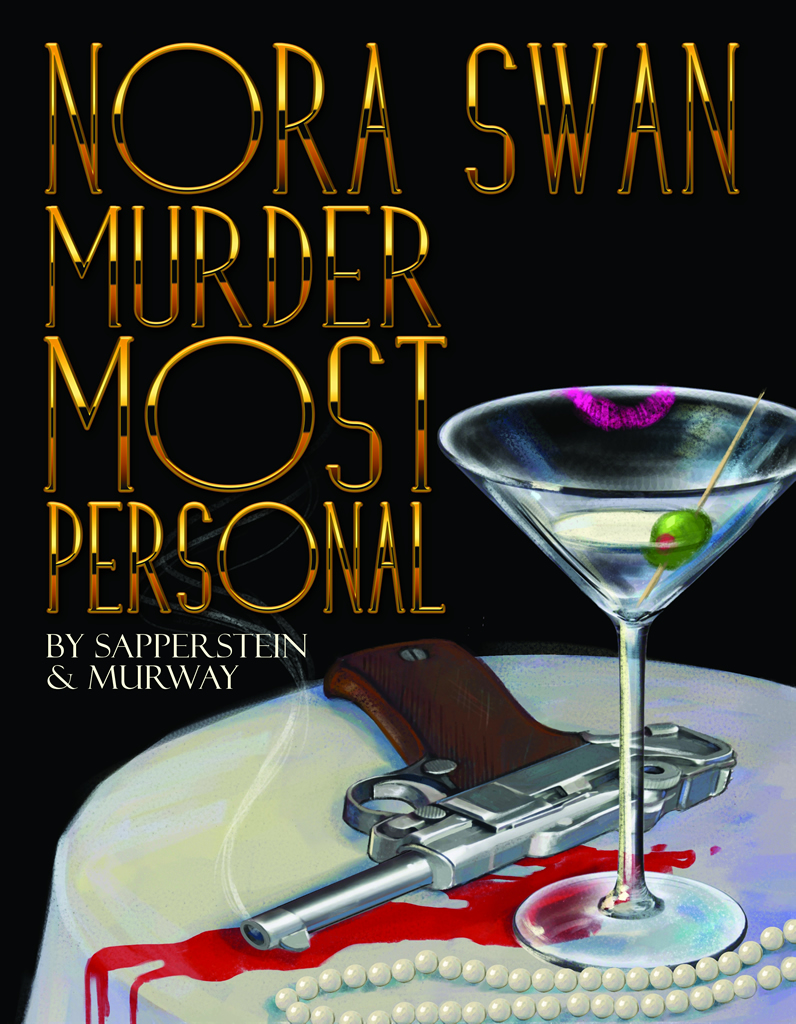
In England, nearing the end of World War II, Richard Swan and his wife Nora were in a terrible car accident that claimed his life and left her blind. It is now 1951, Nora lives in New York City, and an old friend of Richard’s comes into her life with the shocking news that Richard was an OSS Operative and he was in fact, murdered to keep what he knew a secret … and now, those killers were after Nora! But Why?!?
Hi, Tracy here — I’m back again :). This time I bring you “Nora Swan: Murder Most Personal”.
But before I can tell you about the making of this little gem, it’s important to bring you up to speed on something else … you see, Judie has always had this … affliction, if you will. The kind that prevents anyone from wanting to watch movies and tv programs with her, especially murder mysteries. She inevitably ALWAYS figures out the plot and the who-dun-it within the first 10 – 20 minutes of the program and before she thinks it through, blurts it out, ruining it for the rest of us! Do not fret friends, we’ve been working on her for some time and I think it is safe to say that she is now a recovering plot-spoiler!
One day, Gary said to her, “why don’t you write a murder mystery and see who gets your plot before you’re ready.” He was kidding at the time, but the idea stuck with them both and one day, Judie woke from a heavily dream-filled sleep, “I wrote a murder mystery last night,” she says to him over a cup of tea (coffee for him, creamy through an I.V. lol). There was a time this would have had him giving her the oddest looks, with much confusion and a stammered, “just last night?” But not now. The general plot points were shared and the two of them got right to work on filling in all the details and bringing the characters to life.
One day during this creation process, I walked in the office and wound out standing quietly in the back, watching and trying to contain my laughter. I find them quite amusing. She was so focused, “no no no, the blood will spatter that way and it’s all wrong,” to which Gary replies, “but if you shoot from this direction then [so and so] is in the way (yes I just censored myself to save the story for you … will wonders never cease lol). They went on and on about weapons, blood spatter, angles and the like, “bad time?” I asked, to which she replied, “I can’t talk right now, I’m murdering someone.” I just started to chuckle, thinking “oh I hope homeland security isn’t eavesdropping, they just wouldn’t understand.”
Turns out, they weren’t just plotting murder … in their story that is … they were doing a full scene diagram with little shapes that denoted different types of furniture, little people and moving and placing them about to make sure they got the staging right … that it all made sense. I hope they saved those little pieces, could be fun years down the road to stumble across them.
In any event, there’s another little snippet for you from behind the scenes with the Judie and Gary hour. Perhaps next time I’ll delve into a meeting that has Gary on the trampoline, or laying on the floor under the desk all while Judie is … well … flailing :).
Hope you’re having a wonderful day and look forward to working with ya!
All my best,
Tracy Renee